ADAS calibration after a windscreen replacement
If your car has a camera mounted behind the windscreen, that camera has to be recalibrated after the glass is replaced. It is not optional and it is not an upsell.
The camera reads the road through a specified optical window in the glass and judges distance and lane position from what it sees. Move the glass a fraction of a millimetre — which every replacement does — and the camera’s idea of where the world is moves with it. We calibrate on the same visit, so the car leaves finished.
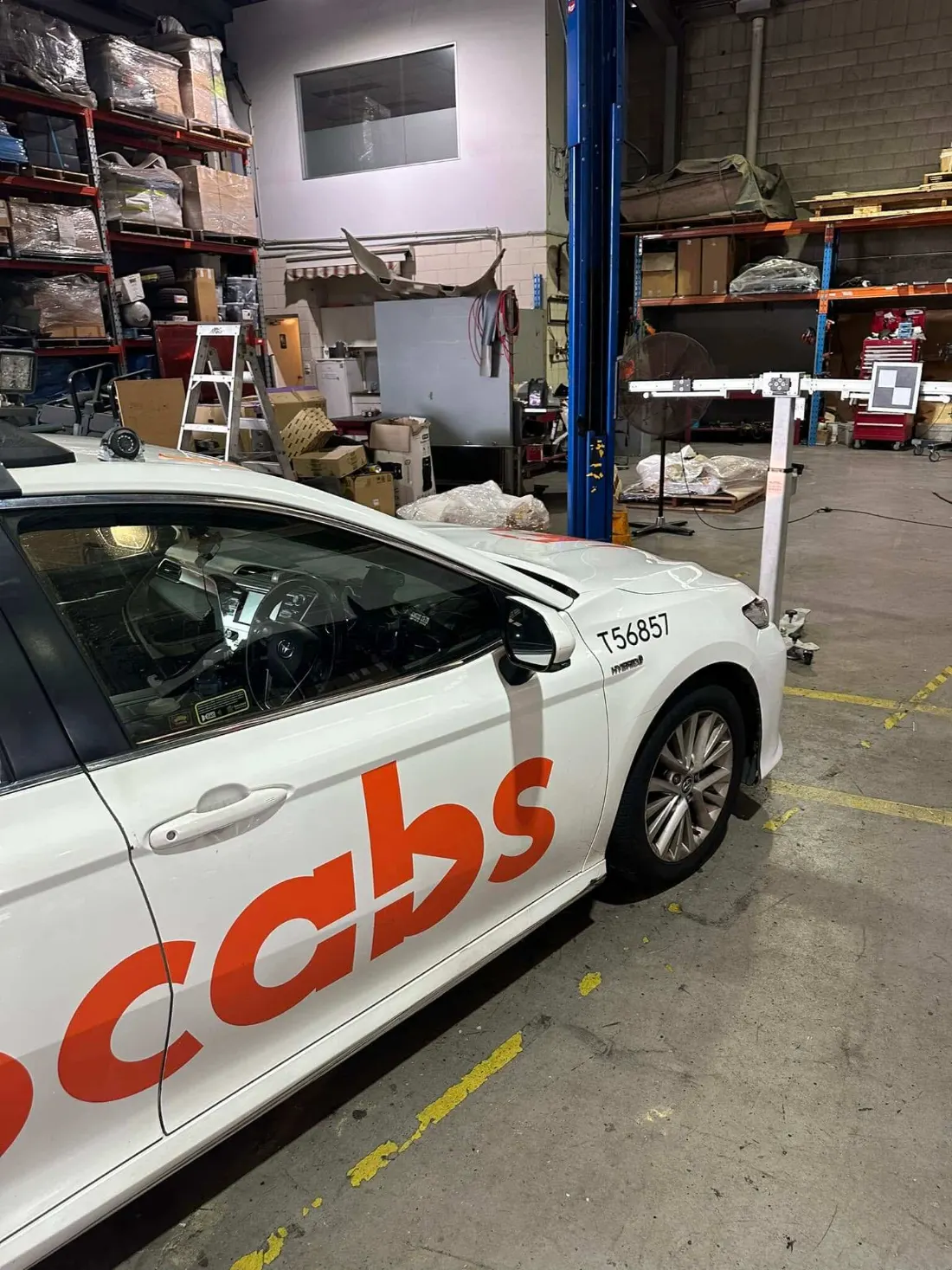
How to tell if your car needs it
Two checks: look at the glass, then look at the features list.
Look up behind the rear-view mirror
From the driver’s seat, look at the back of the mirror housing where it meets the glass. A camera lens, or a black plastic bracket bonded to the screen, means there is a forward-facing camera. Some cars also have a radar unit behind the badge — that one is not affected by glass work.
Check what the car can do
Lane keeping assist or lane departure warning, autonomous emergency braking, adaptive cruise control that holds a gap, traffic sign recognition, automatic high beam. Any of those, on most vehicles, is driven by the camera behind the windscreen.
Assume yes on anything recent
Autonomous emergency braking has been standard on most new cars sold in Australia for years now. If the vehicle is late model, calibration is the default assumption rather than the exception.
Heavy vehicles too
Lane departure warning and forward collision systems are increasingly fitted to prime movers and coaches. The principle is the same and so is the requirement.
Static and dynamic calibration
Which one your vehicle needs is set by the manufacturer, not by us. Some require both, in a specific order.
| Static | Dynamic | |
|---|---|---|
| Where | Level floor, controlled lighting, targets at measured distances | On the road, at a specified speed range |
| What happens | Printed targets placed precisely relative to the vehicle centreline; the camera is taught what it is looking at | The car is driven on well-marked road while the system re-learns lane lines and horizon |
| Needs | Space, level ground, correct targets, tyre pressures and ride height right | Clear lane markings, steady speed, suitable weather |
| Typical time | 30–60 minutes | 15–40 minutes of driving |
| Common on | Many European and Japanese makes | Many Korean and American makes |
A camera aimed one degree off is not one degree wrong.
At the distance the system is judging — the car ahead, the lane line fifty metres out — a fraction of a degree at the lens is metres of error on the road.
What goes wrong when calibration is left out
None of these are hypothetical. All of them are reasons the manufacturer specifies the procedure.
Emergency braking that reads the wrong distance
AEB decides whether to intervene from the camera’s estimate of the gap ahead. An uncalibrated camera can brake for something that is not there, or fail to brake for something that is.
Lane keeping that steers to the wrong place
Lane centring holds the car relative to lines the camera identifies. If the camera’s idea of straight ahead is off, the car tracks off-centre and fights the driver.
Adaptive cruise that misjudges the gap
Following distance is set from the same estimate. Too close is dangerous; too far and the system becomes useless in traffic and gets switched off.
Warning lights and disabled systems
Many vehicles detect the mismatch and simply disable the safety systems, with a dash warning. That is the good outcome — at least you know.
A liability problem you do not want
If the car is in an incident and the safety systems were not calibrated after glass work, that becomes a question. Documented calibration is part of doing the job properly.
Calibration as part of the same visit
The thing that makes this workable is not sending you somewhere else afterwards.
A windscreen replacement on a camera-equipped car is one booking with us: glass out, pinchweld prepped and primed, new glass bonded at the correct bead height, cure time observed, then calibration. Bead height matters more than usual on these cars, because it sets how the glass — and therefore the camera’s optical path — sits relative to the body.
Budget two to two and a half hours on site rather than the sixty to ninety minutes a non-camera car takes. If your vehicle needs a dynamic calibration, part of that is a road drive; we will tell you at booking if that is the case so nobody is surprised.
We fit the glass the camera was specified for. On cars where the optical window in front of the lens has to be exact, that means the genuine part rather than an equivalent — and we will say so when we quote. More on what drives the price is on the cost page.
Keep reading
What is ADAS calibration?
ADAS calibration re-aims the forward-facing camera mounted behind the windscreen so the driver assistance systems it feeds — lane keeping, autonomous emergency braking, adaptive cruise control — correctly judge lane position and distance. It is required after the windscreen is replaced because the new glass never sits in exactly the same place as the old one.
Does my car need calibration after a windscreen replacement?
If there is a camera or a bonded camera bracket behind the rear-view mirror, yes. In practice that means most vehicles with lane keeping assist, autonomous emergency braking, adaptive cruise control or traffic sign recognition — which is most cars sold in Australia in recent years.
How long does calibration take?
A static calibration is typically 30 to 60 minutes on top of the replacement, and a dynamic calibration involves 15 to 40 minutes of driving. Allow two to two and a half hours on site in total for a camera-equipped car, against 60 to 90 minutes for one without.
What is the difference between static and dynamic calibration?
Static calibration uses printed targets set at measured distances from the vehicle on level ground, in controlled lighting. Dynamic calibration re-learns on the road at a specified speed on well-marked lanes. Which one applies is set by the vehicle manufacturer, and some vehicles require both in a specific order.
Can I skip calibration to save money?
No, and we will not fit glass to a camera car and leave it uncalibrated. An uncalibrated camera can brake for nothing, fail to brake for something, or steer the car off-centre. Many vehicles simply disable the safety systems and put a warning light up instead.
Do you charge extra for calibration?
It is part of the quote for a camera-equipped vehicle rather than a surprise added afterwards. Tell us the make, model and year when you call and the price you are given already includes it.
Camera behind the mirror?
Tell us the make, model and year when you call and we will confirm whether your car needs calibration and include it in the quote. It happens on the same visit — no second booking anywhere else.